

Important This Guide assumes basic knowledge on the NeuralForecast library. For a minimal example visit the Getting Started guide.You can run these experiments using GPU with Google Colab.

1. Libraries
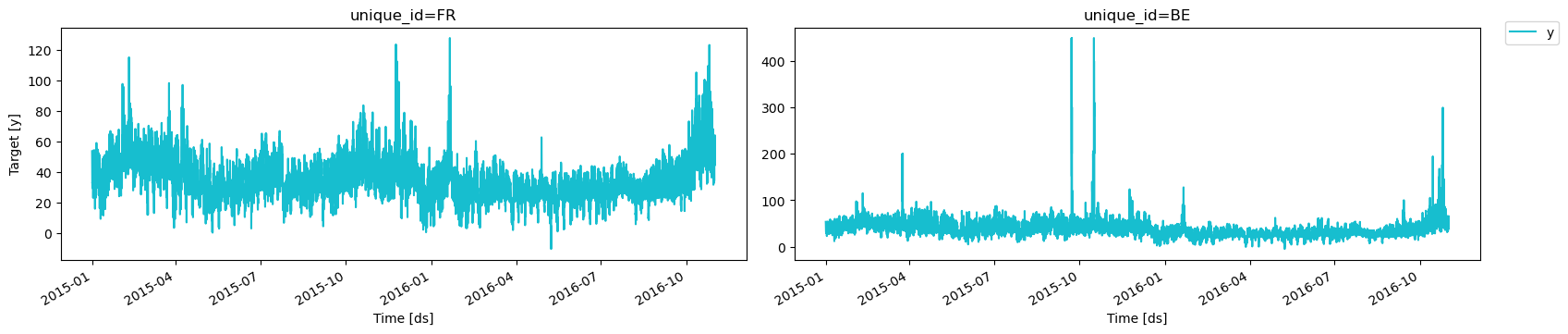
2. Load data
Thedf dataframe contains the target and exogenous variables past
information to train the model. The unique_id column identifies the
markets, ds contains the datestamps, and y the electricity price.
Include both historic and future temporal variables as columns. In this
example, we are adding the system load (system_load) as historic data.
For future variables, we include a forecast of how much electricity will
be produced (gen_forecast) and day of week (week_day). Both the
electricity system demand and offer impact the price significantly,
including these variables to the model greatly improve performance, as
we demonstrate in Olivares et al. (2022).
The distinction between historic and future variables will be made later
as parameters of the model.
Tip Calendar variables such as day of week, month, and year are very useful to capture long seasonalities.
static_df dataframe. In this
example, we are using one-hot encoding of the electricity market. The
static_df must include one observation (row) for each unique_id of
the df dataframe, with the different statics variables as columns.
3. Training with exogenous variables
We distinguish the exogenous variables by whether they reflect static or time-dependent aspects of the modeled data.- Static exogenous variables: The static exogenous variables carry time-invariant information for each time series. When the model is built with global parameters to forecast multiple time series, these variables allow sharing information within groups of time series with similar static variable levels. Examples of static variables include designators such as identifiers of regions, groups of products, etc.
- Historic exogenous variables: This time-dependent exogenous variable is restricted to past observed values. Its predictive power depends on Granger-causality, as its past values can provide significant information about future values of the target variable .
- Future exogenous variables: In contrast with historic exogenous variables, future values are available at the time of the prediction. Examples include calendar variables, weather forecasts, and known events that can cause large spikes and dips such as scheduled promotions.
futr_exog_list,
hist_exog_list, and stat_exog_list. We also set horizon as 24 to
produce the next day hourly forecasts, and set input_size to use the
last 5 days of data as input.
Tip When including exogenous variables always use a scaler by setting thescaler_typehyperparameter. The scaler will scale all the temporal features: the target variabley, historic and future variables.
Important Make sure future and historic variables are correctly placed. Defining historic variables as future variables will lead to data leakage.Next, pass the datasets to the
df and static_df inputs of the fit
method.
Tip You can scale static variables using thelocal_static_scaler_typeparameter when initializing aNeuralForecastinstance.
4. Forecasting with exogenous variables
Before predicting the prices, we need to gather the future exogenous variables for the day we want to forecast. Define a new dataframe (futr_df) with the unique_id, ds, and future exogenous variables.
There is no need to add the target variable y and historic variables
as they won’t be used by the model.
Important Make sureFinally, use thefutr_dfhas informations for the entire forecast horizon. In this example, we are forecasting 24 hours ahead, sofutr_dfmust have 24 rows for each time series.
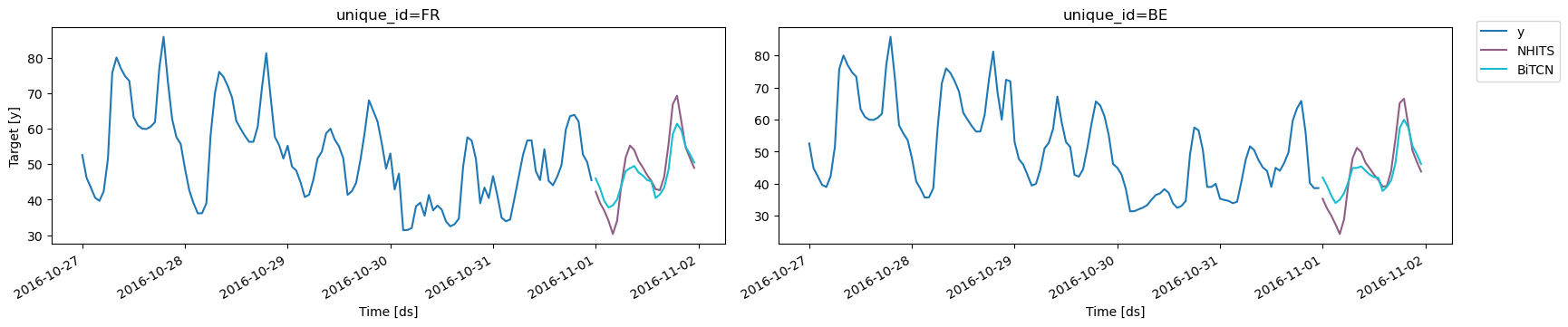
predict method to forecast the day-ahead prices.
- Add temporal exogenous variables as columns to the main dataframe
(
df). - Add static exogenous variables with the
static_dfdataframe. - Specify the name for each variable in the corresponding model hyperparameter.
- If the model uses future exogenous variables, pass the future
dataframe (
futr_df) to thepredictmethod.
References
- Kin G. Olivares, Cristian Challu, Grzegorz Marcjasz, Rafał Weron, Artur Dubrawski, Neural basis expansion analysis with exogenous variables: Forecasting electricity prices with NBEATSx, International Journal of Forecasting
- Cristian Challu, Kin G. Olivares, Boris N. Oreshkin, Federico Garza, Max Mergenthaler-Canseco, Artur Dubrawski (2021). NHITS: Neural Hierarchical Interpolation for Time Series Forecasting. Accepted at AAAI 2023.