

Documentation Index
Fetch the complete documentation index at: https://nixtlaverse.nixtla.io/llms.txt
Use this file to discover all available pages before exploring further.
Long-horizon forecasting is challenging because of the volatility of
the predictions and the computational complexity. To solve this
problem we created the NHITS model
and made the code available NeuralForecast
library.
NHITS specializes its partial outputs in the different frequencies of
the time series through hierarchical interpolation and multi-rate input
processing.
In this notebook we show how to use NHITS on the
ETTm2 benchmark dataset. This
data set includes data points for 2 Electricity Transformers at 2
stations, including load, oil temperature.
We will show you how to load data, train, and perform automatic
hyperparameter tuning, to achieve SoTA performance, outperforming
even the latest Transformer architectures for a fraction of their
computational cost (50x faster).
You can run these experiments using GPU with Google Colab.
1. Installing NeuralForecast
%%capture
!pip install neuralforecast datasetsforecast utilsforecast
2. Load ETTm2 Data
The LongHorizon class will automatically download the complete ETTm2
dataset and process it.
It return three Dataframes: Y_df contains the values for the target
variables, X_df contains exogenous calendar features and S_df
contains static features for each time-series (none for ETTm2). For this
example we will only use Y_df.
If you want to use your own data just replace Y_df. Be sure to use a
long format and have a similar structure to our data set.
import pandas as pd
from datasetsforecast.long_horizon import LongHorizon
# Change this to your own data to try the model
Y_df, _, _ = LongHorizon.load(directory='./', group='ETTm2')
Y_df['ds'] = pd.to_datetime(Y_df['ds'])
# For this excercise we are going to take 20% of the DataSet
n_time = len(Y_df.ds.unique())
val_size = int(.2 * n_time)
test_size = int(.2 * n_time)
Y_df.groupby('unique_id').head(2)
| unique_id | ds | y |
|---|
| 0 | HUFL | 2016-07-01 00:00:00 | -0.041413 |
| 1 | HUFL | 2016-07-01 00:15:00 | -0.185467 |
| 57600 | HULL | 2016-07-01 00:00:00 | 0.040104 |
| 57601 | HULL | 2016-07-01 00:15:00 | -0.214450 |
| 115200 | LUFL | 2016-07-01 00:00:00 | 0.695804 |
| 115201 | LUFL | 2016-07-01 00:15:00 | 0.434685 |
| 172800 | LULL | 2016-07-01 00:00:00 | 0.434430 |
| 172801 | LULL | 2016-07-01 00:15:00 | 0.428168 |
| 230400 | MUFL | 2016-07-01 00:00:00 | -0.599211 |
| 230401 | MUFL | 2016-07-01 00:15:00 | -0.658068 |
| 288000 | MULL | 2016-07-01 00:00:00 | -0.393536 |
| 288001 | MULL | 2016-07-01 00:15:00 | -0.659338 |
| 345600 | OT | 2016-07-01 00:00:00 | 1.018032 |
| 345601 | OT | 2016-07-01 00:15:00 | 0.980124 |
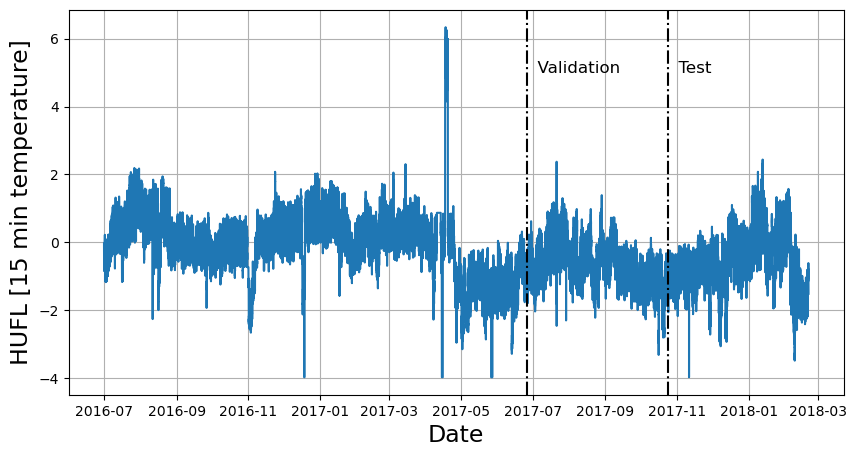
import matplotlib.pyplot as plt
# We are going to plot the temperature of the transformer
# and marking the validation and train splits
u_id = 'HUFL'
x_plot = pd.to_datetime(Y_df[Y_df.unique_id==u_id].ds)
y_plot = Y_df[Y_df.unique_id==u_id].y.values
x_val = x_plot[n_time - val_size - test_size]
x_test = x_plot[n_time - test_size]
fig = plt.figure(figsize=(10, 5))
fig.tight_layout()
plt.plot(x_plot, y_plot)
plt.xlabel('Date', fontsize=17)
plt.ylabel('HUFL [15 min temperature]', fontsize=17)
plt.axvline(x_val, color='black', linestyle='-.')
plt.axvline(x_test, color='black', linestyle='-.')
plt.text(x_val, 5, ' Validation', fontsize=12)
plt.text(x_test, 5, ' Test', fontsize=12)
plt.grid()
3. Hyperparameter selection and forecasting
The AutoNHITS class will automatically perform hyperparamter tunning
using Tune library,
exploring a user-defined or default search space. Models are selected
based on the error on a validation set and the best model is then stored
and used during inference.
The AutoNHITS.default_config attribute contains a suggested
hyperparameter space. Here, we specify a different search space
following the paper’s hyperparameters. Notice that 1000 Stochastic
Gradient Steps are enough to achieve SoTA performance. Feel free to
play around with this space.
from ray import tune
from neuralforecast.auto import AutoNHITS
from neuralforecast.core import NeuralForecast
horizon = 96 # 24hrs = 4 * 15 min.
# Use your own config or AutoNHITS.default_config
nhits_config = {
"learning_rate": tune.choice([1e-3]), # Initial Learning rate
"max_steps": tune.choice([1000]), # Number of SGD steps
"input_size": tune.choice([5 * horizon]), # input_size = multiplier * horizon
"batch_size": tune.choice([7]), # Number of series in windows
"windows_batch_size": tune.choice([256]), # Number of windows in batch
"n_pool_kernel_size": tune.choice([[2, 2, 2], [16, 8, 1]]), # MaxPool's Kernelsize
"n_freq_downsample": tune.choice([[168, 24, 1], [24, 12, 1], [1, 1, 1]]), # Interpolation expressivity ratios
"activation": tune.choice(['ReLU']), # Type of non-linear activation
"n_blocks": tune.choice([[1, 1, 1]]), # Blocks per each 3 stacks
"mlp_units": tune.choice([[[512, 512], [512, 512], [512, 512]]]), # 2 512-Layers per block for each stack
"interpolation_mode": tune.choice(['linear']), # Type of multi-step interpolation
"val_check_steps": tune.choice([100]), # Compute validation every 100 epochs
"random_seed": tune.randint(1, 10),
}
Tip
Refer to https://docs.ray.io/en/latest/tune/index.html for more
information on the different space options, such as lists and
continous intervals.m
To instantiate AutoNHITS you need to define:
h: forecasting horizon
loss: training loss. Use the DistributionLoss to produce
probabilistic forecasts.
config: hyperparameter search space. If None, the AutoNHITS
class will use a pre-defined suggested hyperparameter space.
num_samples: number of configurations explored.
models = [AutoNHITS(h=horizon,
config=nhits_config,
num_samples=5)]
Fit the model by instantiating a NeuralForecast object with the
following required parameters:
The cross_validation method allows you to simulate multiple historic
forecasts, greatly simplifying pipelines by replacing for loops with
fit and predict methods.
With time series data, cross validation is done by defining a sliding
window across the historical data and predicting the period following
it. This form of cross validation allows us to arrive at a better
estimation of our model’s predictive abilities across a wider range of
temporal instances while also keeping the data in the training set
contiguous as is required by our models.
The cross_validation method will use the validation set for
hyperparameter selection, and will then produce the forecasts for the
test set.
%%capture
nf = NeuralForecast(
models=models,
freq='15min')
Y_hat_df = nf.cross_validation(df=Y_df, val_size=val_size,
test_size=test_size, n_windows=None)
4. Evaluate Results
The AutoNHITS class contains a results tune attribute that stores
information of each configuration explored. It contains the validation
loss and best validation hyperparameter.
nf.models[0].results.get_best_result().config
{'learning_rate': 0.001,
'max_steps': 1000,
'input_size': 480,
'batch_size': 7,
'windows_batch_size': 256,
'n_pool_kernel_size': [2, 2, 2],
'n_freq_downsample': [24, 12, 1],
'activation': 'ReLU',
'n_blocks': [1, 1, 1],
'mlp_units': [[512, 512], [512, 512], [512, 512]],
'interpolation_mode': 'linear',
'val_check_steps': 100,
'random_seed': 8,
'h': 96,
'loss': MAE(),
'valid_loss': MAE()}
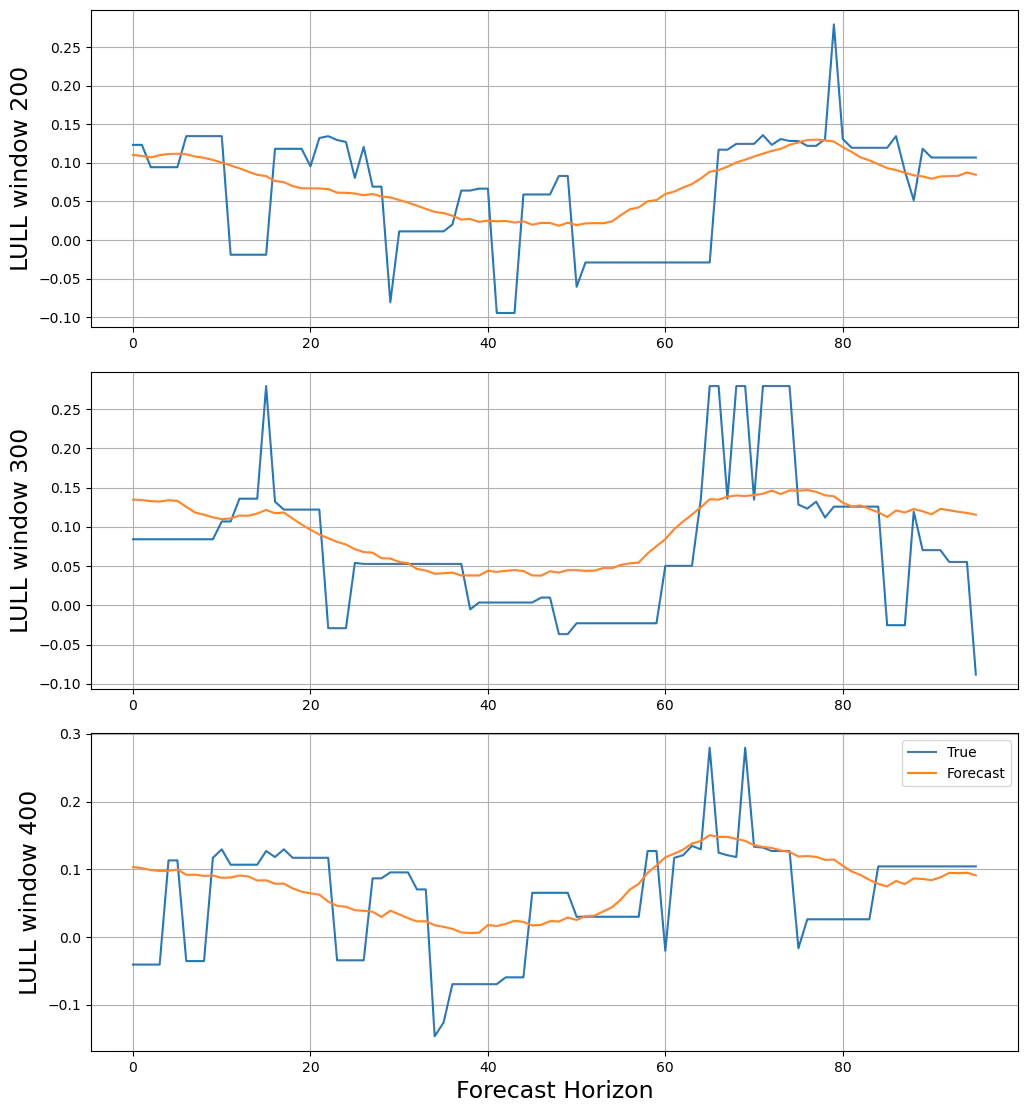
from utilsforecast.plotting import plot_series
series = ['HUFL','HULL','LUFL','LULL','MUFL','MULL','OT']
series_id = series[3] # 'LULL'
series_cutoffs = Y_hat_df.loc[Y_hat_df['unique_id'] == "LULL", 'cutoff'].unique()
for w_idx in [200, 300, 400]:
cutoff = series_cutoffs[w_idx]
plot_df = Y_hat_df.loc[Y_hat_df['cutoff'] == cutoff, ['unique_id', 'ds', 'y', 'AutoNHITS']]
fig = plot_series(
df=plot_df[['unique_id', 'ds', 'y']],
forecasts_df=plot_df[['unique_id', 'ds', 'AutoNHITS']],
ids=[series_id],
models=['AutoNHITS'],
max_insample_length=96
)
display(fig)
Finally, we compute the test errors for the two metrics of interest:
MAE=Windows∗Horizon1∑τ∣yτ−y^τ∣
and
MSE=Windows∗Horizon1∑τ(yτ−y^τ)2
from utilsforecast.evaluation import evaluate
from utilsforecast.losses import mae, mse
eval_df = evaluate(
df=Y_hat_df.drop(columns=["cutoff"]),
metrics=[mae, mse],
agg_fn="mean"
)
print('MAE: ', eval_df.iloc[0]["AutoNHITS"])
print('MSE: ', eval_df.iloc[1]["AutoNHITS"])
MAE: 0.24862242128243706
MSE: 0.17257850996828134
For reference we can check the performance when compared to previous
‘state-of-the-art’ long-horizon Transformer-based forecasting methods
from the NHITS paper. To recover or
improve the paper results try setting hyperopt_max_evals=30 in
Hyperparameter Tuning.
Mean Absolute Error (MAE):
| Horizon | NHITS | AutoFormer | InFormer | ARIMA |
|---|
| 96 | 0.249 | 0.339 | 0.453 | 0.301 |
| 192 | 0.305 | 0.340 | 0.563 | 0.345 |
| 336 | 0.346 | 0.372 | 0.887 | 0.386 |
| 720 | 0.426 | 0.419 | 1.388 | 0.445 |
Mean Squared Error (MSE):
| Horizon | NHITS | AutoFormer | InFormer | ARIMA |
|---|
| 96 | 0.173 | 0.255 | 0.365 | 0.225 |
| 192 | 0.245 | 0.281 | 0.533 | 0.298 |
| 336 | 0.295 | 0.339 | 1.363 | 0.370 |
| 720 | 0.401 | 0.422 | 3.379 | 0.478 |
References
Cristian Challu, Kin G. Olivares, Boris N. Oreshkin, Federico Garza,
Max Mergenthaler-Canseco, Artur Dubrawski (2021). NHITS: Neural
Hierarchical Interpolation for Time Series Forecasting. Accepted at AAAI
2023.