

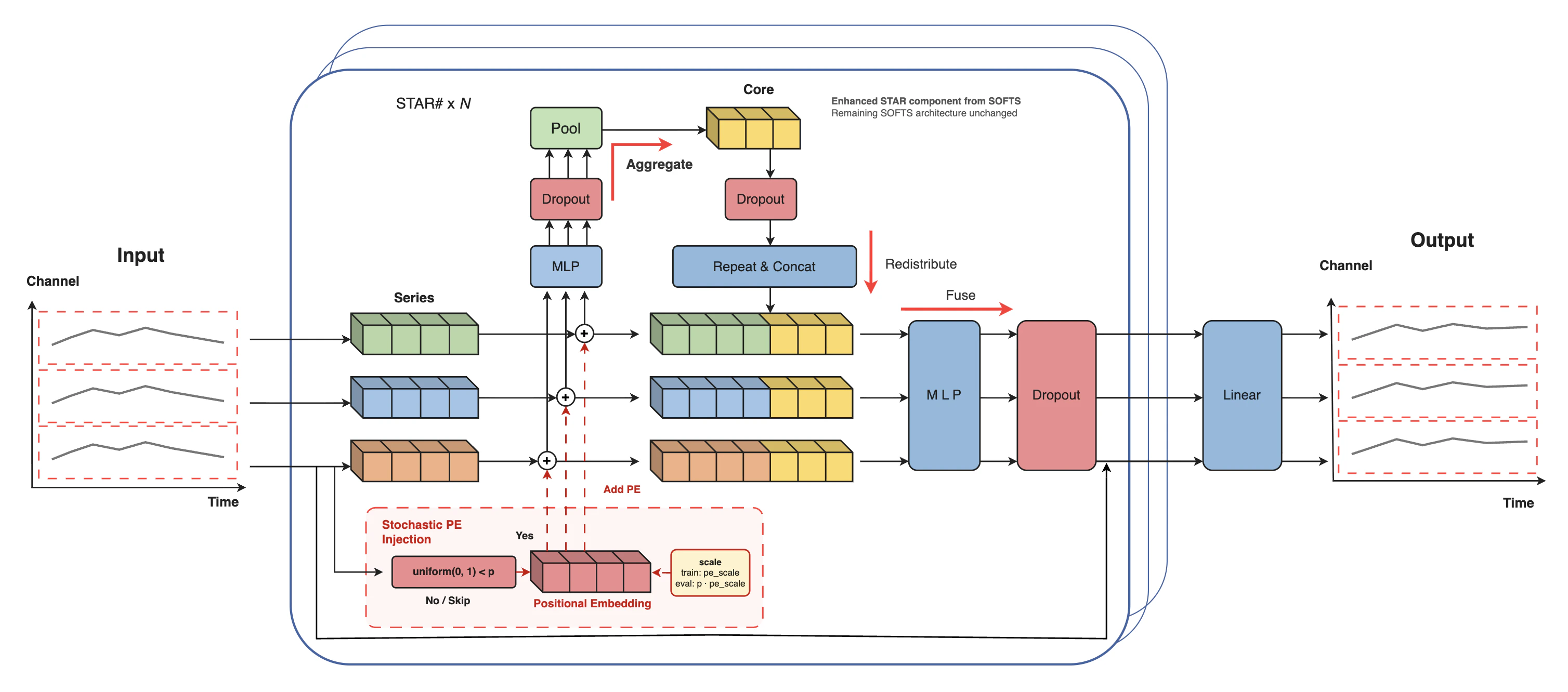
1. SOFTSSharp
SOFTSSharp
BaseModel
SOFTSSharp
SOFTS# (SOFTSSharp) extends SOFTS by stochastically adding
variable-position embeddings and multiple dropout layers inside the STAD
component.
Parameters:
SOFTSSharp.fit
fit method, optimizes the neural network’s weights using the
initialization parameters (learning_rate, windows_batch_size, …)
and the loss function as defined during the initialization.
Within fit we use a PyTorch Lightning Trainer that
inherits the initialization’s self.trainer_kwargs, to customize
its inputs, see PL’s trainer arguments.
The method is designed to be compatible with SKLearn-like classes
and in particular to be compatible with the StatsForecast library.
By default the model is not saving training checkpoints to protect
disk memory, to get them change enable_checkpointing=True in __init__.
Parameters:
Returns:
SOFTSSharp.predict
Trainer execution of predict_step.
Parameters:
Returns:
Usage example
2. Auxiliary functions
PositionalEmbedding
Module
STADSharp
Module
STar Aggregate Dispatch Module with stochastic variable-position encoding.