h | int | Forecast horizon. | required |
input_size | int | autorregresive inputs size, y=[1,2,3,4] input_size=2 -> y_[t-2:t]=[1,2]. | required |
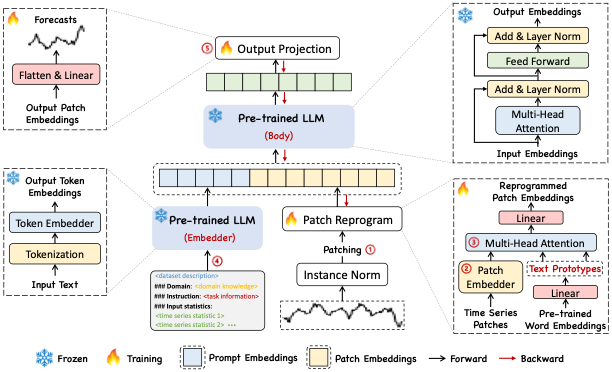
patch_len | int | length of patch. Default: 16 | 16 |
stride | int | stride of patch. Default: 8 | 8 |
d_ff | int | dimension of fcn. Default: 128 | 128 |
top_k | int | top tokens to consider. Default: 5 | 5 |
d_llm | int | hidden dimension of LLM. Default: 768 # LLama7b:4096; GPT2-small:768; BERT-base:768 | 768 |
d_model | int | dimension of model. Default: 32 | 32 |
n_heads | int | number of heads in attention layer. Default: 8 | 8 |
enc_in | int | encoder input size. Default: 7 | 7 |
dec_in | int | decoder input size. Default: 7 | 7 |
llm | str | Path to pretrained LLM model to use. If not specified, it will use GPT-2 from https://huggingface.co/openai-community/gpt2” | None |
llm_config | dict | Deprecated, configuration of LLM. If not specified, it will use the configuration of GPT-2 from https://huggingface.co/openai-community/gpt2” | None |
llm_tokenizer | str | Deprecated, tokenizer of LLM. If not specified, it will use the GPT-2 tokenizer from https://huggingface.co/openai-community/gpt2” | None |
llm_num_hidden_layers | int | hidden layers in LLM. Default: 32 | 32 |
llm_output_attention | bool | whether to output attention in encoder. Default: True | True |
llm_output_hidden_states | bool | whether to output hidden states. Default: True | True |
prompt_prefix | str | prompt to inform the LLM about the dataset. Default: None | None |
dropout | float | dropout rate. Default: 0.1 | 0.1 |
stat_exog_list | list | static exogenous columns. | None |
hist_exog_list | list | historic exogenous columns. | None |
futr_exog_list | list | future exogenous columns. | None |
loss | PyTorch module | instantiated train loss class from losses collection. | MAE() |
valid_loss | PyTorch module | instantiated valid loss class from losses collection. | None |
learning_rate | float | Learning rate between (0, 1). Default: 1e-3 | 0.0001 |
max_steps | int | maximum number of training steps. Default: 1000 | 5 |
val_check_steps | int | Number of training steps between every validation loss check. Default: 100 | 100 |
batch_size | int | number of different series in each batch. Default: 32 | 32 |
valid_batch_size | int | number of different series in each validation and test batch, if None uses batch_size. Default: None | None |
windows_batch_size | int | number of windows to sample in each training batch, default uses all. Default: 1024 | 1024 |
inference_windows_batch_size | int | number of windows to sample in each inference batch. Default: 1024 | 1024 |
start_padding_enabled | bool | if True, the model will pad the time series with zeros at the beginning, by input size. Default: False | False |
training_data_availability_threshold | Union[float, List[float]] | minimum fraction of valid data points required for training windows. Single float applies to both insample and outsample; list of two floats specifies [insample_fraction, outsample_fraction]. Default 0.0 allows windows with only 1 valid data point (current behavior). | 0.0 |
step_size | int | step size between each window of temporal data. Default: 1 | 1 |
num_lr_decays | int | Number of learning rate decays, evenly distributed across max_steps. Default: -1 | 0 |
early_stop_patience_steps | int | Number of validation iterations before early stopping. Default: -1 | -1 |
val_monitor | str | metric to monitor for early stopping. Valid options: “ptl/val_loss”, “valid_loss”, “train_loss”. Default: “ptl/val_loss“ | ‘ptl/val_loss’ |
scaler_type | str | type of scaler for temporal inputs normalization see temporal scalers. Default: ‘identity' | 'identity’ |
random_seed | int | random_seed for pytorch initializer and numpy generators. Default: 1 | 1 |
drop_last_loader | bool | if True TimeSeriesDataLoader drops last non-full training batch. Default: False | False |
alias | str | optional, Custom name of the model. | None |
optimizer | Subclass of ‘torch.optim.Optimizer’ | optional, user specified optimizer instead of the default choice (Adam). | None |
optimizer_kwargs | dict | optional, list of parameters used by the user specified optimizer. | None |
lr_scheduler | Subclass of ‘torch.optim.lr_scheduler.LRScheduler’ | optional, user specified lr_scheduler instead of the default choice (StepLR). | None |
lr_scheduler_kwargs | dict | optional, list of parameters used by the user specified lr_scheduler. | None |
dataloader_kwargs | dict | optional, list of parameters passed into the PyTorch Lightning dataloader by the TimeSeriesDataLoader. | None |
**trainer_kwargs | int | keyword trainer arguments inherited from PyTorch Lightning’s trainer. | |